Biomagnets: Understanding and designing sensing experiences.

Some background
Magnetic implants appeared in the early 2010’s within the biohacking community and have since evolved significantly in both design and use. Their design has mostly evolved through community efforts, private research, and manufacturing constraints. They are usually optimized for one of two things: sensing or lifting.
At first glance, the concept of sensing is simple: a tiny magnet under the skin is pushed and pulled by other magnets and fields. This allows the user to "feel" said fields. The reality is much more intricate: biocompatibility, placement, shape, strength, haptic properties, and neural plasticity make sensing a fascinating field of study with many opportunities.
My name is Axel, and I’ve devoted a few years of my life to studying sensory substitution and addition through magnet implants. When I first heard of them, it didn’t take much to convince me. As opposed to close-range, readable chips like NFC and RFID, which have very specific applications, I saw magnets as the starting point for what human enhancement could be. I felt like they were to the human body what drivers are to a computer.
Since then, I’ve had multiple of them in various shapes and coatings, both DIY and manufactured, and at the time of writing this article, I have five of them in my right hand.
Over time, I've studied the haptic properties of subdermal magnets (commonly called "sensing"). I was lucky to get both the academic world and the community involved, and it resulted in the development of software and hardware devices to take advantage of, study, and play with "sensing".
Skin anatomy basics
Imagine your nervous system as a tree branching from the brain into thinner and thinner branches ending in nerve endings. Each nerve can be seen as a cable carrying electromechanical signals called action potentials. They usually carry messages from the brain to the organs, but in the case of sensory nerves, the signal goes the other way: In sensory nerves, information is transmitted from your sensory receptor neurons to the main nerve system and eventually to the brain. Stimuli on these sensory neurons produce potentials in the corresponding nerve.
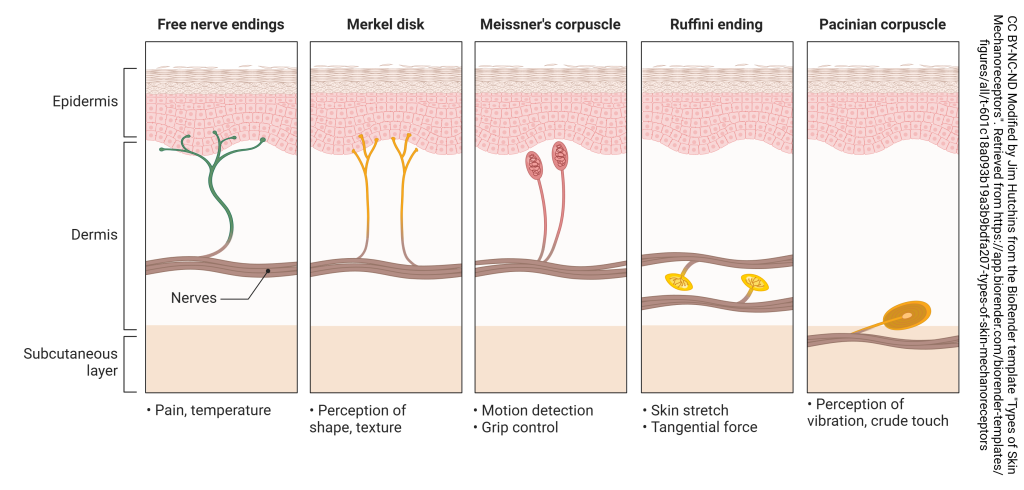
It is the skin’s mechanoreceptors, the nerve endings dedicated to touch, that are involved in sensing. Their role is to inform the brain of the skin's deformation and movement.
It is the quickly adapting mechanoreceptors that are mostly involved in the perception of a magnet's movement. They are mostly composed of:
- Pacinian corpuscles that are sensitive to the frequency range 200–300 Hz
- Meissner corpuscles that are sensitive to the frequencies around 50 Hz
These loosely define the detectable frequency range of sensing.
Magnet shape and design
The shape and making of the magnet play a significant role in the haptic properties it will deliver.
Biocompatibility
A biomagnet must withstand the challenging conditions inside the human body, be safe, and go unnoticed by the immune system; it must do that for long periods of time, ideally for a lifetime. This is called biocompatibility.
Unfortunately, the stronger magnet chemistries that are applicable to sensing are not inherently compatible with the human body. They require a coating or shell to isolate them from the body.
In addition to its protective role, the coating is subject to other constraints. Its mass and volume have to be minimal in order to reduce its impact on the magnet's performance. We generally aim for the smallest coating-to-magnet mass ratio. A heavier or larger implant will be less mobile when exposed to external fields because of its own inertia and its contact surface with the tissue around it.
Shape, size, and strength
The shape of the implant will have an impact on its interaction with the surrounding tissue when it is pulled, vibrates, or physically flips to align with a strong field.
Rounder ones will have a tendency to flip more easily, while large aspect ratio ones like discs will tend to keep their orientation.
The size of a magnet impacts its mass but also its strength. A larger, stronger magnet will interact more with its surroundings, but it also has more mass and inertia, and so will require more energy to move. This movement will also be dampened, making it less reactive to higher frequencies — faster movement.
Magnet strength is usually straightforward: stronger means more sensitivity. That said, the magnet's chemistry is also subject to some constraints. For example, Neodymium, which is currently the strongest option on the market, is heat-sensitive and will degrade in a standard autoclave. This makes it difficult for users to sterilize without expensive equipment, so a slightly less strong option with comparable performance can sometimes be preferable.
Magnetic field basics
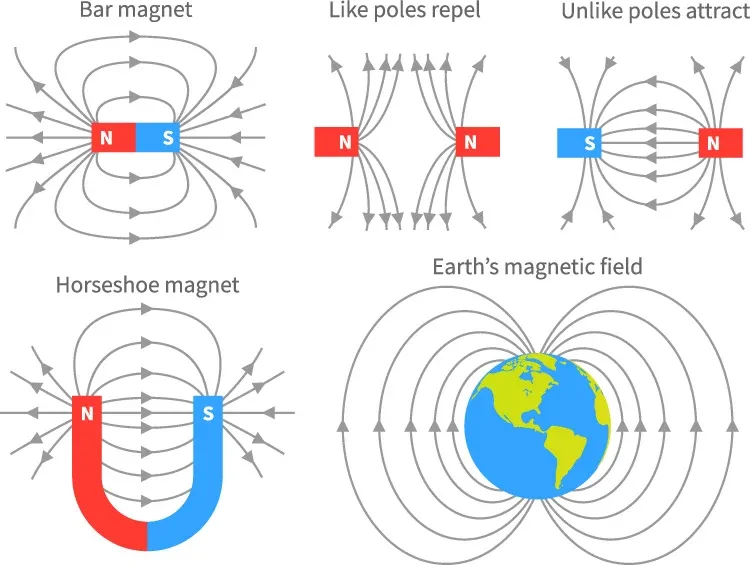
We are all familiar with a magnet. It has a north and a south pole that interact with other magnets and ferrous objects. To be more precise, there is a magnetic field produced around the object, usually represented by field lines going from one pole to the other.
This field has a shape, and its strength decreases with distance. This kind of field can also be produced by current running through a wire (usually wound in a coil to amplify the effect). That is called an electromagnet, and it can be turned on and off.
But electromagnets can go further. The current running through them can be reversed many times a second (alternating current), and as you can imagine, this makes the field's poles flip just as fast. In fact, any kind of signal (i.e. audio) can be run through the electromagnet, and the corresponding field will be produced. This is how conventional speakers work.
All these fields, whether they are static, alternating, or more complex, can be felt and differentiated with biomagnets, and this is what makes them useful.
Sensitivity and basic stimulation
Whether we want to design biomagnets, choose implant locations, or use sensing, it is useful to characterize and understand the haptic properties of sensing. Don't be scared; it will all make sense.
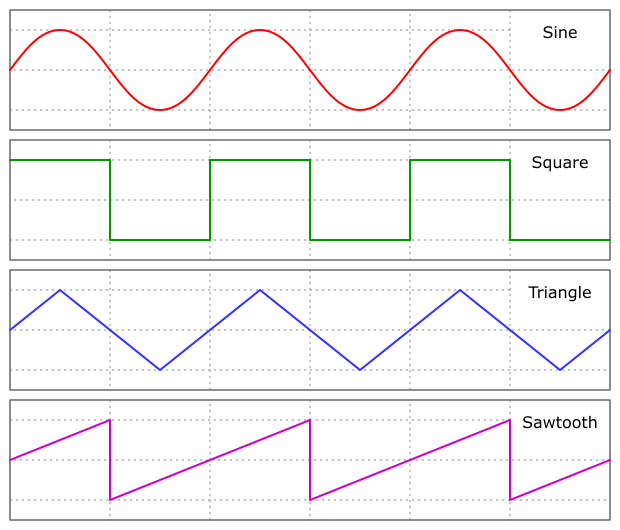
For this, we use simple periodic signals, like a sine wave. We vary their strength (amplitude), their speed (frequency), and their shape (saw, square...) to identify the usable ranges of sensing.
Amplitude detection
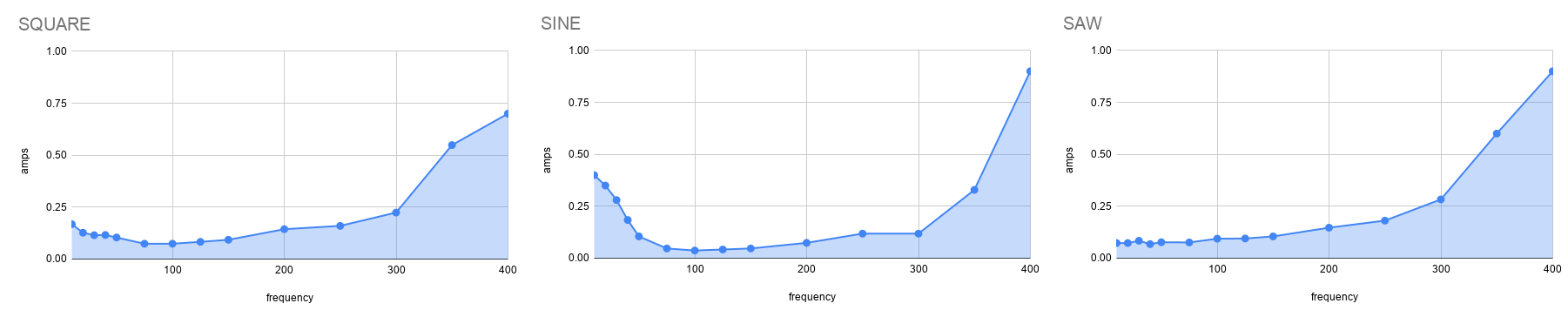
What we are interested in is the amplitude detection threshold (the faintest detectable signal) relative to frequency.
The usable frequency range for biomagnets is typically 0-500Hz.
In this range, we observe a high and relatively constant sensitivity in the 50-300Hz with an ideal zone at 80-150Hz. Outside of these ranges, the sensitivity diminishes quickly.
Shape response
It is important to mention that the shape of the signal impacts both the sensitivity properties and the user's perception.
For example, the sharper falloffs and rises in amplitude of a square wave and the sharp spikes of a saw wave compared to a sine wave make them much more noticeable in the 0-50Hz range. Lowering the amplitude detection threshold and expanding the optimal range to 0-150Hz.
Signal perception
Various signals will feel different, and although the correlation is intuitive, it is hard to describe because it is very subjective. For example, a smooth sine wave might feel like a soft hum, while a sharp square wave might feel like an aggressive buzz.
Here is an attempt at describing roughly the perception of the basic signals:
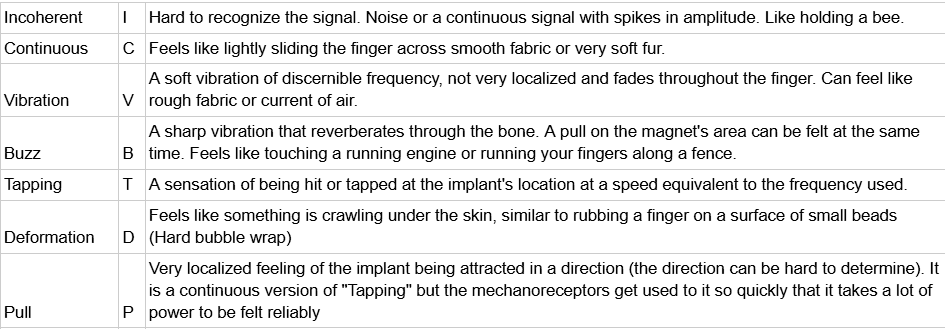
- Square waves at low frequencies (<20Hz) tend to produce T with a bit of D. Over 20Hz the sensation turns into V or B. As frequency increases, it turns into a very smooth C. At any frequency, a signal that is too strong turns into an unpleasant B.
- Sawtooth waves at low frequencies produce a very sharp D that transitions very quickly through T and B when increasing frequency to end in a very clean and sharp C. Again, at any frequency, a signal that is too strong turns into an unpleasant B.
- A triangle wave is noisier in C and makes D much smoother.
- Sine waves produce strong but smooth D in low frequencies (<20Hz) that almost feel like the entire fingertip is being shaken. Then it quickly transitions to a relatively smooth B from 30Hz to 100Hz and from 100Hz to 200Hz we transition from B to C. Under 200Hz a large amplitude will produce a B, but over that, it is just a C getting stronger. This makes sines much more pleasant at high amplitudes.
Basic stimulation
What we learn from experimenting with simple signals like these can be used to design basic tactile feedback with optimal "loudness" and intended "feel". It is similar to designing the beeps and boops in audio feedback. But why stop there?
Complex stimulation and brain plasticity
Static fields and simple signals help us understand the capabilities of biomagnets and help us design stimulation specifically for them. But what other kind of data can we run through them? And how does the brain interpret new information input? Here are a few examples.
Sound, voice, and music
Audio signals can be run through biomagnets. It is one of the easiest setups, but it provides a lot of possible experimentation.
First, we must be aware of the usable frequency range. The typical encoded audio frequency range is 0-20kHz. Thankfully, the 50Hz-10kHz contains most of the musically important information, while 100Hz-5kHz contains a huge proportion of what makes music recognizable and intelligible.
This is still a much wider range than our 0-500Hz, so we have two options:
- We produce the signal as is, knowing that only the lowest frequencies will be retained. This is actually not that bad, and famous songs as well as basic sounds can be recognized despite the lossy input.
- We remap the audio by compressing the entire signal or a larger part into our usable range. This would most likely have better results, but it can be challenging, especially in real-time applications. A protocol still needs to be established for the ideal compression that minimizes distortion and loss while giving the best clarity.
Finally, since we understand the typical curve of amplitude detection of a biomagnet, we can equalize our signal so that all frequencies are felt uniformly. This, as well, is challenging to implement but has shown clear improvements in the past on simpler interactive experiences.
Training, learning, and plasticity
Brain plasticity is a well-studied subject, and as an example, some of David M. Eagleman's research with vibrotactile pattern learning can be almost directly applied to biomagnets.
The general idea is that senses are not set in stone. The way the brain interprets signals from the body's sensory neurons is something malleable that adapts when presented with change or training. In other words, nothing is theoretically stopping the brain from re-routing sense and, for example, interpreting the signal from your skin as sound or the signal from your hearing as an image.
Just by using sensing regularly, multiple user including myself, have reported "hearing" a frequency as a tone or even "hearing" music in their head when stimulating their magnet with it. This, of course, is a long process involving the formation of habits that progressively rewire the brain to try and "make sense" of a new input. It is also a difficult phenomenon to document.
An interesting thing to develop would be a training protocol and tool that accelerates this process with a predefined goal such as understanding speech or hearing tones...
Data and sensor feedback
Another avenue to explore is real-time feedback from either a digital data stream or sensors.
We can envision biomagnets as an input to the brain, independent of the other senses. This opens up a lot of possibilities, especially if we think of continuous real-time feedback from onboard sensors. Some examples:
- Expanding the perceived electromagnetic range with UV, IR, radio, light... sensors to "see" or "feel" invisible fields, navigate in the dark, aid for the visually impaired...
- Artificial ear using real-time microphones to compensate for hearing impairment, upgraded hearing, directional hearing, expanding the audible range...
- Distance/obstacle sensors for navigation in the dark, for the visually impaired...
- Vitals and heartbeat sensors for real-time awareness of health, sports, stress management... It is theorized that a constant awareness of ones heart beat would, over time, allow the user to regulate it consciously.
The data stream doesn't have to come from sensors. In fact, it can be anything: navigation instructions, notifications, live stock market, traffic data, climate data, gaming feedback, safety warnings... For example, a thesis by Ian Michael Harrison (2014) explores the use of biomagnets for real-time feedback to racing pilots, a high-stress situation where all other senses must be unimpaired.
Another inspiring study by David M. Eagleman is the VEST (Versatile Extra-Sensory Transducer). It converts data streams into patterns of vibration on the torso. He has specifically discussed feeding real-time stock-market data into the vest and having the wearer make trading decisions based only on the tactile patterns, without consciously knowing what the signals represented.
Similar data feeds can be envisioned for biomagnets, which are more discreet and sensitive than surface vibrators.
Haptics for virtual worlds and new experiences
Again, why stop here? We've seen how intricate biomagnet stimulation can be. And we live at a time when virtual worlds are expanding our own. Part of the challenge with that is artificially manipulating one's senses to project them into a virtual environment: sight requires bulky goggles, hearing requires headphones, and touch... well, touch is not even close to anything commercially viable. So what humble contribution can biomagnets have, and can they solve any of the issues of existing bulky "haptic gloves"?
Spatial feedback
Now imagine the user in a virtual environment, whether that's through a screen or a virtual/augmented reality setup. They are facing a virtual cactus; they reach out their finger towards the needles and... Ouch! Well, this scenario poses a few challenges:
- We need the precise position of the user's hands in space to calculate their interactions with the virtual environment.
- We require a device that will produce the magnetic feedback at the finger's location in real-time.
- We need to generate realistic feedback in real time based on the finger-object interaction, reflecting force, texture, mechanical interaction, and movement.
It is challenging but not science fiction. And that is probably my proudest contribution to the field:
Simulating pressure and texture
Once we have the full interaction between the user's fingers and the object, including penetration, perpendicular velocity, and parallel velocity, it is possible to use some clever tricks to give the impression of touching an actual object.
By modulating the signal and carefully selecting the signal type, it is even possible to give the impression of texture: [1:43]
To expand on that, it is even possible, using the same techniques to simulate soft objects, liquids, or wind...
Mechanical interaction feedback
One of the simplest and probably most successful forms of haptic feedback with biomagnets is the mechanical interaction. Think of the "click" when flipping a switch, the little impacts when turning a gear, or the snapping of a latch.
All these little interactions are what make an interaction realistic, and it turns out they are quite simple to implement. This is thanks to the realisation that the sound of such an interaction is a very good approximation of the mechanical movement. It is the movement of air resulting from that movement, after all.
And since we already know we can route sound into a biomagnet, it is pretty straightforward. And guess what, it works remarkably well out of the gate.
It can then, of course, be optimised with better sound recording, audio processing, and timing adjustments: [1:31]
Vector fields and navigation
More complex experiences are possible as well. One example is projecting the user inside a vector field. Said fields can contain information in the form of intensity, direction, or distance. This can be sent to the user based on their position, the direction they are pointing, or their velocity.
For example, I was able to test that by setting up a virtual treasure hunt in a virtual room full of objects. The user had to find three hidden objects by pointing around and following the field.
Designing haptic experiences
Now that we have some ideas, let's talk about implementing them and the challenges we face.
Field generation
During a 3D virtual simulation, we need a precise field to be generated at the exact location of the biomagnet while it is moving around. This is particularly difficult for a few reasons:
- The magnetic field strength decreases with the inverse-cube law over distance. That means it drops off exponentially, so producing anything at a distance is a challenge and requires powerful equipment.
- Magnetic fields are hard to shape. They can be unintuitive, and focusing them in a specific direction is a challenge, let alone generating a complex shape.
There are two main approaches to this issue:
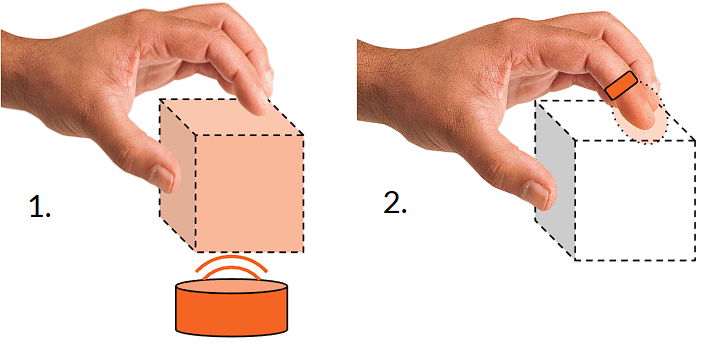
- 1. Spatial projection. A fixed setup projects a large field around it or a beam in the user's direction. While it sounds great at a small scale, it is nearly impossible to scale up. This approach is ideal for desktop applications in a small volume of space. For example, projecting 3D shapes over a keyboard or a table.
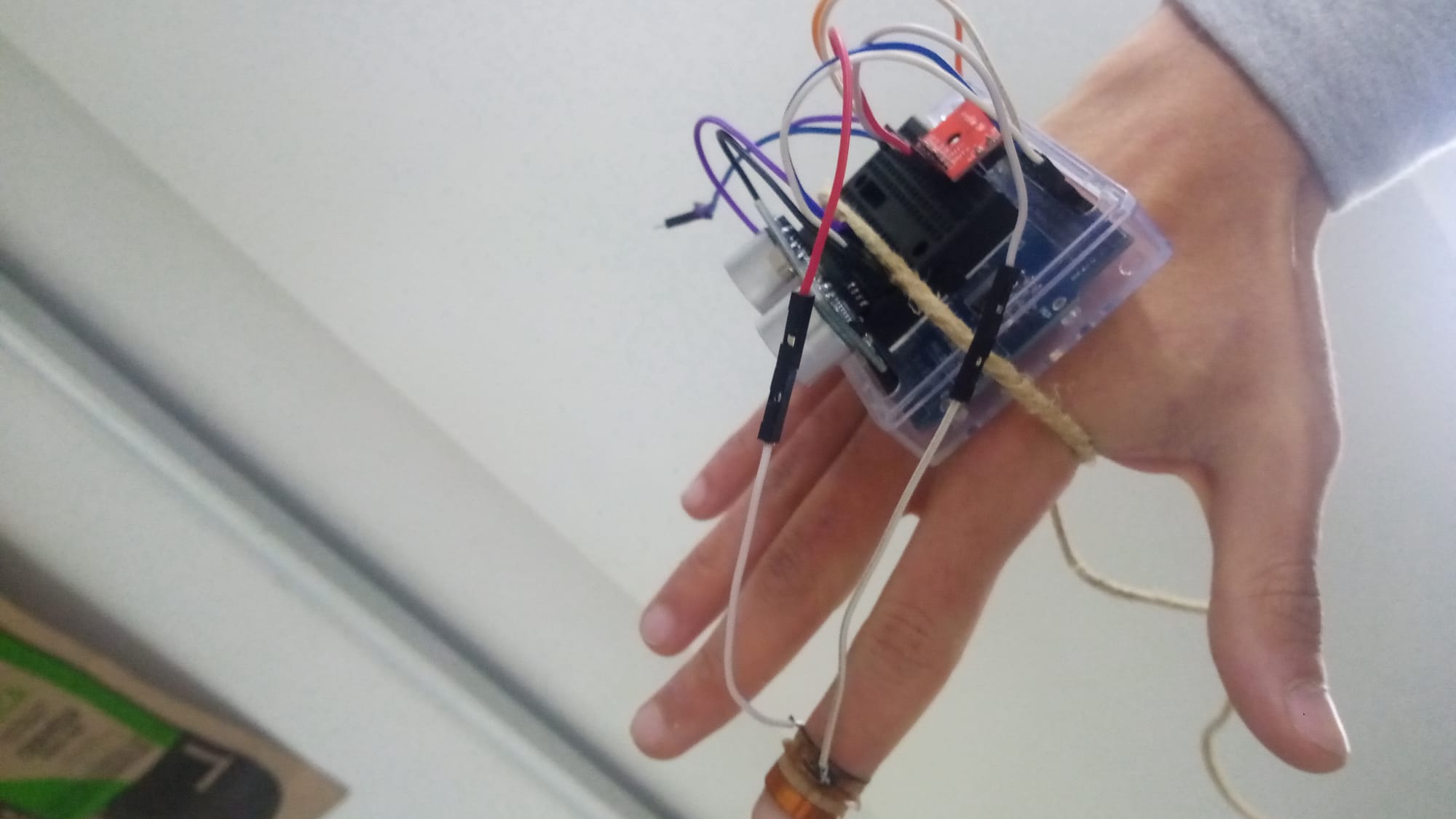
- 2. Wearable setup. It is worn on the arm, hand, or finger, or directly over the implant. This is a more cumbersome but much easier option since the field can be uniform and at a fixed distance from the biomagnet. This can be a ring, a bracelet, or a combination.
Hand tracking
For realistic interactions, precise hand tracking is necessary, and this is probably the biggest obstacle for larger-scale experiences.
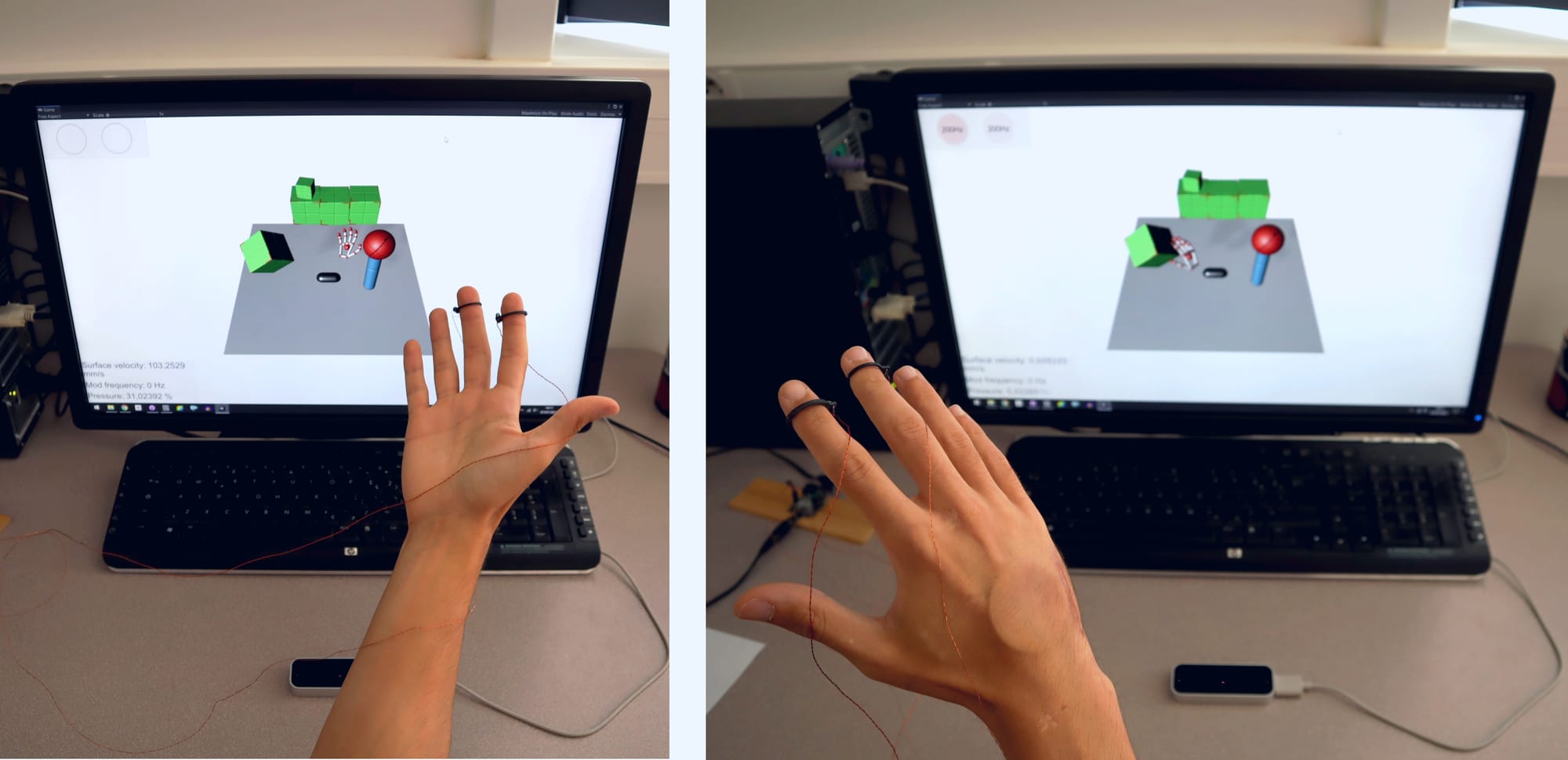
At desktop scale, stereovision devices like the LeapMotion provide decent hand tracking, but at room scale and beyond, it is either impossible or not accurate enough.
One possible option would be to have the LeapMotion mounted on the person or their headset. This has been done and is probably the only option for now.
Collision and penetration
While we can simulate touch quite precisely in thin air, we can't generate resistance. No matter how realistic the texture, we won't be able to make it solid, and the user will inevitably be able to pass through it.
There are some workarounds that are more or less viable depending on the application:
- Ignore the issue. VR is quite good at tricking the mind already. With realistic interactions, it's more than likely that users will behave as they would in the real world anyway and won't mind.
- Make the inside of objects uncomfortable. When the user goes too far inside an object, the signal becomes aggressive or uncomfortable. This triggers a pull-back reaction, and over a short time it unconsciously teaches the user to not do that.
- Take advantage of real surfaces. Whether they're part of the room or some kind of moving surface, it is possible to map virtual textures and interactions on a very real surface.