Living with a magnetic implant
Everyday tips for coexisting with your implant
Medical issues and health
MRIs
There are no major medical drawbacks to a magnetic implant, other than you should avoid MRIs.
Magnetic resonance imaging, as the name indicates, uses strong magnetic fields. Your magnet won’t fly out of your body like a bullet, but it might distort the imaging and could also be painful. If you ever have to have one, here is what you should do:
First of all, this is not something new. Medical implants like pacemakers, rods, screws, and artificial joints are common, and the medical personnel are trained to deal with them. If you ever have to undergo an MRI the first thing to do is to tell the technician about your implant. From there on, they will make a decision and let you know. In the worst-case scenario, you could get it removed, but the chances that you have to do that are quite low. Usually, an alternative imaging method will be used or some preventive measure will be put in place.
But what if you’re unconscious?
Emergency card
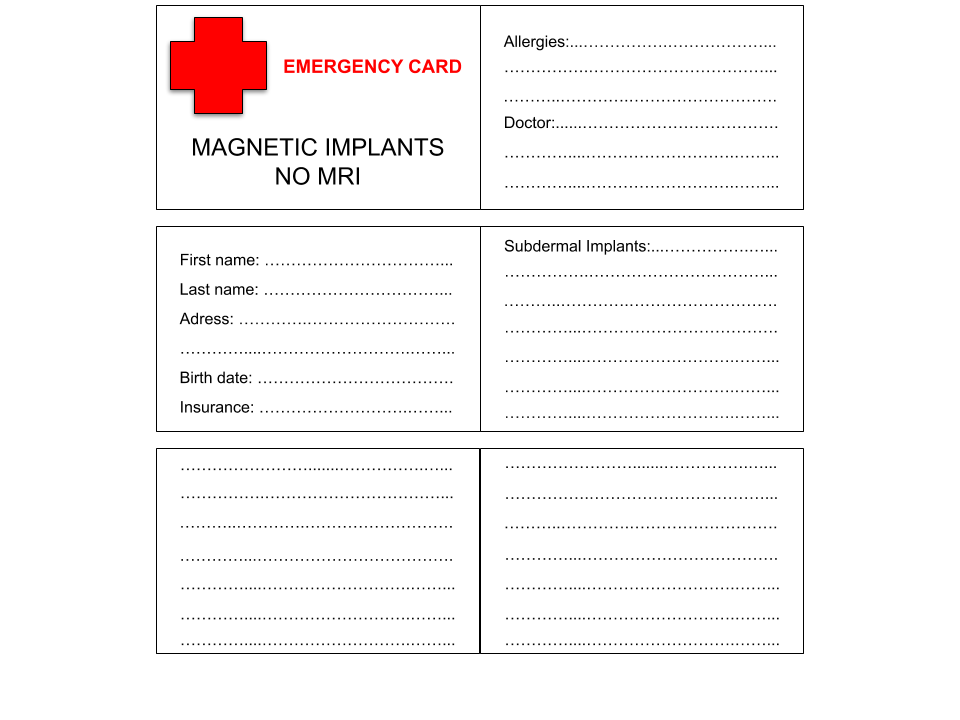
We strongly recommend carrying a medical emergency card with your medical info and a big ‘NO MRI’ with some details on your implants. Again, this is something doctors are used to (usually for serious allergies or diseases), and if you are ever brought to the hospital unconscious, they should look in your pockets for emergency contacts and IDs. You would commonly carry your medical card in your wallet, as this is one of the first things the emergency services will check. Note that printing and filling a basic template like this one in this post is sufficient.
You can also find “No MRI” bracelets and cards online. Note that it is not required by any law to carry those; it’s just a recommendation.
Did you know your phone has an emergency info feature? Look it up, it should be in “emergency call” on the locked screen. Make sure to fill it out.
Injuries
Overall, it’s quite safe to have an implant. The only cases you should worry about are in case of a deep cut or a serious injury in the implant’s location. If a blade or any other hard object has or might have made contact with it, and there is an open wound, then the coating might be compromised, and it’s reasonable to remove it or keep an eye on it just in case. This is especially true for thin or soft coatings. Thankfully, the Lodestones are encased in titanium, which is remarkably durable.
In case of a hard impact (think hammer) where the skin isn’t compromised, then your implant is probably fine. Still keep an eye on it for the following week and get it checked if anything weird shows up. The coating might have rubbed against your bone.
It’s very unlikely for an implant to break, especially with new and better coatings. While some glass-encased magnets have had issues with the tips of the capsules breaking off, this is pretty uncommon and not an issue with titanium. In any case, it’s a good idea to keep your doctor and your close ones informed.
Migrating or annoying implants
It’s not unheard of for an implant to move around under your skin. This usually happens during healing, but don’t be surprised. If this ever happens, you basically have three options:
- Deal with it. You don’t mind the new placement and can’t be bothered to remove it, so why not keep it there?
- It hurts or annoys you. Get it removed or replaced by someone with the skill to do so.
- It moves around easily. Push it back where it should be. Whether you push it with your finger or pull it with a magnet, be very, very careful. After you do so, make sure it stays there by applying pressure around it. In a couple of weeks, your tissue should have started growing back around it, and it should stabilize. This is a long and painstaking process that requires some patience, so make sure you are well-informed before starting.
Pro-Tips and Amateur Moves
You can’t touch this
Beware of large magnets (very large and strong ones). First of all, they’ll make your implant spin around, and that’s not a great feeling. Also, if one ever got stuck to it, you would scream as your skin gets pinched like never before. Removing it would be even worse. This is no joke. I recommend always having an object between your implant and the magnet if you really want to play with those.
If you are not interested, relax. Such large magnets aren’t found in regular households, and your average fridge magnet is perfectly fine to play with.
Large electromagnets have various industrial applications, but unless you are ever asked to get rid of anything metallic when walking in a room, you should be fine.
Beware of anything sharp. This is just common sense, but piercing the skin over your implant wouldn’t be a good idea. Another thing to consider is fine metallic powder; it is theoretically possible that a very fine shard of metal could be pulled through the skin surface. To avoid that, be careful while handling iron fillings or anything similar. If any sticks to the implant region, get rid of it and clean the area well.
Handling electronics
You really shouldn’t worry about damaging electronics. None of the modern electronics is sensitive to such small magnetic fields. You might want to be careful if you ever handle old devices that involve magnetic tape, but these are pretty uncommon, and you would still have to intentionally rub your magnet on the tape itself to do any damage.Note that your magnet will obviously mess with compasses, including the one in your phone, while following GPS directions, for example. No worries though! Just hold it in your other hand.
Heal up before you play
When it comes to playing with it, sensing and lifting, it’s perfectly fine as long as it’s fully healed and doesn’t hurt. Note that sticking stuff to it for long periods of time is dangerous, as the skin is pinched and not irrigated properly anymore. A few minutes is fine, but don’t leave it for hours.
Sports and activities
Being a practitioner of extreme sports myself, I can assure you that a cleverly placed implant will never get in your way. If it does, you probably didn’t think enough about it before getting it. Again, it’s not that difficult to get it moved or removed, but try to think of a placement that suits you this time.
You should also take into consideration that you get used to it over time. You might be noticing it all the time, but in a few months, it will feel like your little toe; you don’t know it’s there until you hit it on the kitchen table.
Your implant over time
Commercially available magnets barely lose any strength over time (less than 1% in 10 years). That means you won’t notice any difference unless human life expectancy hugely increases over the next decades. Also, neodymium (the most heat-sensitive type) will start demagnetizing at temperatures above 100°C, but at that point, you should be more concerned about being on fire.